Showing posts with label Zero Soda. Show all posts
Showing posts with label Zero Soda. Show all posts
Friday, February 22, 2013
Zero Soda - The pitch
Like bottled water and soda, but hate the waste? Drink guilt-free with Zero Soda. Zero Soda results in near zero waste and with Zero Soda’s pricing model, the more you save the planet the more you save your wallet.

Thursday, February 21, 2013
Zero Soda - The fun part
I think there are two fun challenges with Zero Soda. The first is design: mechanical, metallurgical, and industrial. Designing the soda machine to fill, dispense, and clean bottles all without needing frequent repair will be no easy feat. The most distinctive aspect of Zero Soda will be the bottles. They will be extremely well engineered, designed to survive drops onto concrete without a scratch. They would also probably have an RFID chip or something else to track individual bottles. Giving $2 per bottle will surely entice some into trying to create counterfeits. Also, RFID chips could be used to track which machines are dispensing the most bottles that get returned and also the least.
Wednesday, February 20, 2013
Zero Soda - The growth potential
The soda business in the US has $75 billion in sales per year. The bottled water businesses is also quite large, 9 billion gallons per year in the US. Translating that into money, it’s around another $75 billion. Taking a little more than a 10% chunk of either of those pies would make Zero Soda a ten plus billion dollar a year company.
Tuesday, February 19, 2013
Zero Soda - The monetization
Now, let me talk about the business side. Zero Soda will strike deals with retail businesses that get foot traffic, e.g., grocery stores, to place the machine in their stores and to connect water lines and electricity to the Zero Soda machine. The soda machines only need to be filled with empty bottles, bottle caps, CO2 canisters, syrup, and other condensed flavorers. These will be replaced as needed by a stocker. Although Zero Soda works differently than normal soda machines, it still has about the same capacity in terms of bottles.
A typical soda machine can have 5 rows, 7 columns, and be 6 sodas deep or 210 sodas total. This means that a stocker will need to come to restock after around 200 bottles are dispensed. If half of the time people come with their own bottle and get it refilled, then the cost of restocking is amortized over 400 bottles. Assuming it takes the stocker an hour to go from the stocking/bottle cleaning location to the machine and back and the stocker is paid $20/hour, that’s five cents per bottle in labor cost.
The cost of syrup is around $35 for 5 gallons of syrup. That amounts to around 200 16-ounce bottles or 18 cents per bottle. That could be as low as 10 cents if the sodas were on the less sweet side. Compared to the syrup, the cost of CO2 is miniscule. In addition to soda, the machine could dispense Hint-like drinks. By their nature, the Hint-like beverages would use very little of the natural flavoring per bottle and could cost less than 10 cents per bottle.
The cost of normal glass soda bottles at scale is around ten to fifty cents. Zero Soda bottles will cost far more than normal, I expect between $1.50 and $2. These will be bottles that are extremely tough and chip and scratch resistant. Imagine a bottle made out of Gorilla Glass. Because they will be tough, they’ll have the possibility of being reused hundreds or thousands of times. One of the goals of the pricing scheme is to heavily incentivize customers to reuse the bottles.
The only other costs to consider are the electricity cost, water cost, space cost, and offsite bottle cleaning costs. The electricity and water cost will come out to be less than a penny per bottle. The cost of renting the space will be around $25 per month. If a machine sells 25 bottles a day, that would add 3 cents of cost to every bottle.
The total cost per bottle accounting for the syrup, labor, utilities, and space for the machine is 26 cents per bottle, just to fill it. In the case where the customer has the machine steam-clean and refill the bottle, Zero Soda could charge 50 cents for a 24 cent profit. If a bottle is returned (for $2 paid to the customer), washed off-site, and returned to the machine empty, I expect it would cost about 10 cents per bottle for the transport and washing. So, a returned bottle costs around $2.35 and sells for $3.50, which is a profit of $1.15, much better than the re-fill. The most profit comes from the first purchase, either $1.15 or $1.65, depending on the manufacturing cost of the bottles.
A typical soda machine can have 5 rows, 7 columns, and be 6 sodas deep or 210 sodas total. This means that a stocker will need to come to restock after around 200 bottles are dispensed. If half of the time people come with their own bottle and get it refilled, then the cost of restocking is amortized over 400 bottles. Assuming it takes the stocker an hour to go from the stocking/bottle cleaning location to the machine and back and the stocker is paid $20/hour, that’s five cents per bottle in labor cost.
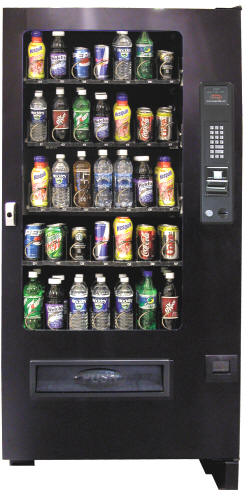
The cost of syrup is around $35 for 5 gallons of syrup. That amounts to around 200 16-ounce bottles or 18 cents per bottle. That could be as low as 10 cents if the sodas were on the less sweet side. Compared to the syrup, the cost of CO2 is miniscule. In addition to soda, the machine could dispense Hint-like drinks. By their nature, the Hint-like beverages would use very little of the natural flavoring per bottle and could cost less than 10 cents per bottle.
The cost of normal glass soda bottles at scale is around ten to fifty cents. Zero Soda bottles will cost far more than normal, I expect between $1.50 and $2. These will be bottles that are extremely tough and chip and scratch resistant. Imagine a bottle made out of Gorilla Glass. Because they will be tough, they’ll have the possibility of being reused hundreds or thousands of times. One of the goals of the pricing scheme is to heavily incentivize customers to reuse the bottles.
The only other costs to consider are the electricity cost, water cost, space cost, and offsite bottle cleaning costs. The electricity and water cost will come out to be less than a penny per bottle. The cost of renting the space will be around $25 per month. If a machine sells 25 bottles a day, that would add 3 cents of cost to every bottle.
The total cost per bottle accounting for the syrup, labor, utilities, and space for the machine is 26 cents per bottle, just to fill it. In the case where the customer has the machine steam-clean and refill the bottle, Zero Soda could charge 50 cents for a 24 cent profit. If a bottle is returned (for $2 paid to the customer), washed off-site, and returned to the machine empty, I expect it would cost about 10 cents per bottle for the transport and washing. So, a returned bottle costs around $2.35 and sells for $3.50, which is a profit of $1.15, much better than the re-fill. The most profit comes from the first purchase, either $1.15 or $1.65, depending on the manufacturing cost of the bottles.
Monday, February 18, 2013
Zero Soda - The Idea
I want to make a beverage company that produces zero waste. Here’s how it’ll work.
You are feeling thirsty so you go to a Zero Soda machine and order a drink for three dollars and fifty cents. Out comes a distinctive glass bottle with your beverage of choice: plain soda, diet soda, flavored soda, plain water, mint water, or other naturally flavored waters. The bottle shows that you’re drinking Zero Soda, the bottle cap is the only thing that says what flavor you are drinking. When the drink is dispensed, the machine lets to know that you will get money back if you return the empty bottle to a Zero Soda machine.
Later, you take your bottle to a Zero Soda machine and are given the choice of two dollars back for the bottle or a refill for fifty cents. You opt for the refill and put your bottle in the machine. The machine then steam cleans the bottle, fills it with liquid delight, and gives the bottle back to you. Throughout this process there is near zero waste. The bottle cap is probably the only thing that won’t get recycled all of the time. This makes Zero Soda the first of its kind: a consumer consumption model that results in near zero waste.
Also worth noting is that the machines would communicate the status of the machine wirelessly to the Zero Soda servers using the cell network. The things it would communicate are how much of the syrups and other ingredients are left, how many bottles there are, how much money the machine has collected, and whether the machine will need maintenance soon.
You are feeling thirsty so you go to a Zero Soda machine and order a drink for three dollars and fifty cents. Out comes a distinctive glass bottle with your beverage of choice: plain soda, diet soda, flavored soda, plain water, mint water, or other naturally flavored waters. The bottle shows that you’re drinking Zero Soda, the bottle cap is the only thing that says what flavor you are drinking. When the drink is dispensed, the machine lets to know that you will get money back if you return the empty bottle to a Zero Soda machine.
Later, you take your bottle to a Zero Soda machine and are given the choice of two dollars back for the bottle or a refill for fifty cents. You opt for the refill and put your bottle in the machine. The machine then steam cleans the bottle, fills it with liquid delight, and gives the bottle back to you. Throughout this process there is near zero waste. The bottle cap is probably the only thing that won’t get recycled all of the time. This makes Zero Soda the first of its kind: a consumer consumption model that results in near zero waste.
Also worth noting is that the machines would communicate the status of the machine wirelessly to the Zero Soda servers using the cell network. The things it would communicate are how much of the syrups and other ingredients are left, how many bottles there are, how much money the machine has collected, and whether the machine will need maintenance soon.
Sunday, February 17, 2013
Zero Soda - The motivation
We waste a lot in our society. We have many products that are thrown in landfills after a single use. One of the most commonly used examples is soda/water bottles. A lot of energy and non-renewable (petroleum) resources go into making these bottles only to get thrown away.
Subscribe to:
Posts (Atom)