In 2015, total global revenue for digital cameras is expected to be $43 billion. Of that $43 billion, around $17 billion is expected to be digital SLRs. If SSLR was able to grab 10% of the market, that would mean it would have almost two billion dollars in revenue per year.
Thursday, February 28, 2013

Wednesday, February 27, 2013
SSLR - The monetization
This is pretty straight forward. SSLR makes cameras and sells them to customers. SSLR would also likely bundle free software with the camera to make post processing easier.
Ideas for real businesses with monetization and growth potential
Software - Retail
Line Hopper - An app that lets users skip the line at restaurants
Publisher Payback - A website that helps users pay back the websites you use the most
Modern Art Share - A service that allows users to share your art with others for money
Modern Art Share - A service that allows users to share your art with others for money
Inner City Banking - A bank designed for the inner city (no predatory lending)
Simple Shopper - A website that makes shopping on small retailer sites painless
Virtual Robotics - Software that allows for rapid prototyping of robots
The Elf Shop - A service that makes holiday shopping easy
Community Bonds - A service that helps brings businesses to communities that want them
Shame These Apps - An app that tells users which apps ask for too many permissions
Village in Crisis - An app that allows users to kill time for the betterment of humanity
Virtual Robotics - Software that allows for rapid prototyping of robots
The Elf Shop - A service that makes holiday shopping easy
Community Bonds - A service that helps brings businesses to communities that want them
Shame These Apps - An app that tells users which apps ask for too many permissions
Village in Crisis - An app that allows users to kill time for the betterment of humanity
Software - Enterprise
Model Gambler - A company that helps casinos optimize profits via A/B testing
Talent-on-Demand - A website that puts idle employees to work
Virtual Scout - Software that makes it easy for coaches to study film on opponents
Translation Hierarchy - A service that provides cost effective high quality translations
Medical Summary Software - Software that makes it easy to understand patient history
House Basketball - Software that uses computer vision to predict game outcomes
Virtual Scout - Software that makes it easy for coaches to study film on opponents
Translation Hierarchy - A service that provides cost effective high quality translations
Medical Summary Software - Software that makes it easy to understand patient history
House Basketball - Software that uses computer vision to predict game outcomes
Hardware - Retail
Zero Soda - A soda company that produces zero waste
SSLR - A camera that makes taking great photos easy
SSLR - A camera that makes taking great photos easy
The Perfect Tailor - A company that scans users bodies to perfectly tailor jeans
Super Green Clean - A laundry service that saves water, energy and money
Lean Green Gems - A jeweler that uses synthetic stones and custom designs for every customer
Empowering the Deaf - A device that helps the hearing impaired interact with people around them
Cold Vault - A refrigerator that sips energy instead of gulping it
Digital Cane - A device that makes possible to the visually impaired to 'see' the world around them
Unique T's - A service to print small numbers of copies of t-shirt designs
Rapid Home Construction - A new method to quickly construct and deconstruct homes
Video Board Games - A board that combines the best of video and board games
Supporting Artists - Headphones that tally what you listen to, so you can donate to artists
Some Assembly Required - Furniture that tells you next steps as you assemble
Lean Green Gems - A jeweler that uses synthetic stones and custom designs for every customer
Empowering the Deaf - A device that helps the hearing impaired interact with people around them
Cold Vault - A refrigerator that sips energy instead of gulping it
Digital Cane - A device that makes possible to the visually impaired to 'see' the world around them
Unique T's - A service to print small numbers of copies of t-shirt designs
Rapid Home Construction - A new method to quickly construct and deconstruct homes
Video Board Games - A board that combines the best of video and board games
Supporting Artists - Headphones that tally what you listen to, so you can donate to artists
Some Assembly Required - Furniture that tells you next steps as you assemble
Hardware - Enterprise
One Person Camera Crew - A camera that does the work of an entire film crew
Fresh Test Sensors - A company that help determine is food was save during transport
Acoustic Cardiac Monitor - A device that listens to hearts to find arrhythmias and abnormalities
Fresh Test Sensors - A company that help determine is food was save during transport
Acoustic Cardiac Monitor - A device that listens to hearts to find arrhythmias and abnormalities
Public Sector
Smoke Scout - A UAV that spot wildfires before they get out of control
DC Desalination - A desalination plant that runs on waste heat from datacenters
Cirrus Traffic - A UAV that monitors traffic and can give feedback about dangerous driving
Micro Meets - A website that auctions off changes to meet celebrities
Cirrus Traffic - A UAV that monitors traffic and can give feedback about dangerous driving
Internet
Hater Network - A social network designed to bitch about product and brands
City Hopper Airlines - An airline that is flexible with departure times
Last Mile Solutions - A service that helps getting around the gaps in transportation infrastructure
Transportation
City Hopper Airlines - An airline that is flexible with departure timesLast Mile Solutions - A service that helps getting around the gaps in transportation infrastructure
Tuesday, February 26, 2013
SSLR - The idea (part 2)
Shutter speed
One effect that usually requires a tripod is taking very long exposure images, e.g., night shots of traffic or waterfalls. Like tripod use in general, this could be handled by taking many short exposure images and creating the blurring by using super resolution techniques (aligning and averaging).
Landscape Photography and HDR
Landscape photography can be amazingly beautiful. Unfortunately, it is also a huge pain in the ass. You basically have two times of the day where you can take good landscape photographs: dawn and dusk. The reason is that during the day, the sun casts harsh shadows on everything making them look pretty ugly. At dawn and dusk, there isn’t any direct sunlight and everything looks evenly lit.
Now, using software we can get almost the same effect during the day. During day shots, there are areas of the scene that are directly illuminated by the sun and others that are indirectly illuminated (and much much dimmer). Using widely different exposure times, it’s possible to capture all of the detail in the indirectly illuminated regions as well as the directly illuminated areas. Better yet, if a surface or texture is directly and indirectly illuminated then it’s possible to match the colors and make the entire surface look like it’s indirectly illuminated. The result is that everything looks like light is indirectly hitting it like it would be during dawn or dusk.
There are some caveats here though. The biggest one is that light that hits a surface can reflect onto other ones, e.g., wearing a green shirt can make your face look a little green. This technique cannot account for that.
This HDR photography is already available on current smart phones. So, it’s really not really a stretch. The difference between what’s used right now and my idea is that I hope to fully compensate for lighting not just make it look a little better.
White Balance
Many DSLRs today comes with GPS sensors, which means the cameras know where they are. If you are outside, the camera could know that and set the white balance accordingly. If you are inside, then it could know that too. Also, if someone else has been inside the same building at roughly the same location and taken a photo, all of that information could be used to determine the white balance. Lastly, if you take a picture of the same thing many times, say a friend who you drag along on your photo adventures or a hat, you can use how those objects look in different photos to help figure out the white balance.
One thing that all of these features have in common is processing. The SSLR camera will need to come with a beefy processor or graphics chip set.
One effect that usually requires a tripod is taking very long exposure images, e.g., night shots of traffic or waterfalls. Like tripod use in general, this could be handled by taking many short exposure images and creating the blurring by using super resolution techniques (aligning and averaging).
Landscape Photography and HDR
Landscape photography can be amazingly beautiful. Unfortunately, it is also a huge pain in the ass. You basically have two times of the day where you can take good landscape photographs: dawn and dusk. The reason is that during the day, the sun casts harsh shadows on everything making them look pretty ugly. At dawn and dusk, there isn’t any direct sunlight and everything looks evenly lit.
Now, using software we can get almost the same effect during the day. During day shots, there are areas of the scene that are directly illuminated by the sun and others that are indirectly illuminated (and much much dimmer). Using widely different exposure times, it’s possible to capture all of the detail in the indirectly illuminated regions as well as the directly illuminated areas. Better yet, if a surface or texture is directly and indirectly illuminated then it’s possible to match the colors and make the entire surface look like it’s indirectly illuminated. The result is that everything looks like light is indirectly hitting it like it would be during dawn or dusk.
There are some caveats here though. The biggest one is that light that hits a surface can reflect onto other ones, e.g., wearing a green shirt can make your face look a little green. This technique cannot account for that.
This HDR photography is already available on current smart phones. So, it’s really not really a stretch. The difference between what’s used right now and my idea is that I hope to fully compensate for lighting not just make it look a little better.
White Balance
Many DSLRs today comes with GPS sensors, which means the cameras know where they are. If you are outside, the camera could know that and set the white balance accordingly. If you are inside, then it could know that too. Also, if someone else has been inside the same building at roughly the same location and taken a photo, all of that information could be used to determine the white balance. Lastly, if you take a picture of the same thing many times, say a friend who you drag along on your photo adventures or a hat, you can use how those objects look in different photos to help figure out the white balance.
One thing that all of these features have in common is processing. The SSLR camera will need to come with a beefy processor or graphics chip set.
Monday, February 25, 2013
SSLR - The idea (part 1)
Most of the problems outlined above can be solved with technology. I’ll take them on one at a time. One thing that is important for most of these solutions is the mechanics of the digital SLR camera. Normal SLRs have a mirror that moves up and down to change where the light from the scene is going (either up to the viewfinder or down to the image sensor). This means that you can’t be looking at the scene and taking a picture at the same time. Also, it limits the rate at which you can do continuous shooting (if you still get to look at the viewfinder between shots). An example of SLR-like cameras that don’t have this problem are the new Sony cameras. The only moving part in these cameras is the shutter. Also any MILC camera could also work. That’ll be important very soon.
Tripods and shutter release
Tripods are considered critical for getting ‘tack sharp’ photographs. Every small movement can cause blurring, especially when using a zoom lense. If you are really serious, you use a shutter release to take the picture, even the act of gently pressing the button can cause blurring.
To take really sharp shots, you don’t need all that stuff. What you need is for the camera to take dozens of shots with a short exposure time, say 1/50 or 1/100 seconds, and then use super resolution techniques to align the images and produce a single ‘tack sharp image.’ Also, to improve the sharpness of individual image, one could put accelerometers on it and do de-convolution using the accelerometer data.
Tripods and shutter release
Tripods are considered critical for getting ‘tack sharp’ photographs. Every small movement can cause blurring, especially when using a zoom lense. If you are really serious, you use a shutter release to take the picture, even the act of gently pressing the button can cause blurring.
To take really sharp shots, you don’t need all that stuff. What you need is for the camera to take dozens of shots with a short exposure time, say 1/50 or 1/100 seconds, and then use super resolution techniques to align the images and produce a single ‘tack sharp image.’ Also, to improve the sharpness of individual image, one could put accelerometers on it and do de-convolution using the accelerometer data.
Sunday, February 24, 2013
SSLR - The motivation
Taking great photographs can be really hard. If you read Scott Kelby’s book, it’s hard not to come away a little depressed. You should use a tripod and a shutter release. Be sure to set ISO to 100. You should probably get a neutral grey card to get the white balance right. If you’re interested in landscape photography, you only have two times a day to shoot, dawn and dusk.
Does it really need to be this hard?
Does it really need to be this hard?
Friday, February 22, 2013
Zero Soda - The pitch
Like bottled water and soda, but hate the waste? Drink guilt-free with Zero Soda. Zero Soda results in near zero waste and with Zero Soda’s pricing model, the more you save the planet the more you save your wallet.
Thursday, February 21, 2013
Zero Soda - The fun part
I think there are two fun challenges with Zero Soda. The first is design: mechanical, metallurgical, and industrial. Designing the soda machine to fill, dispense, and clean bottles all without needing frequent repair will be no easy feat. The most distinctive aspect of Zero Soda will be the bottles. They will be extremely well engineered, designed to survive drops onto concrete without a scratch. They would also probably have an RFID chip or something else to track individual bottles. Giving $2 per bottle will surely entice some into trying to create counterfeits. Also, RFID chips could be used to track which machines are dispensing the most bottles that get returned and also the least.
Wednesday, February 20, 2013
Zero Soda - The growth potential
The soda business in the US has $75 billion in sales per year. The bottled water businesses is also quite large, 9 billion gallons per year in the US. Translating that into money, it’s around another $75 billion. Taking a little more than a 10% chunk of either of those pies would make Zero Soda a ten plus billion dollar a year company.
Tuesday, February 19, 2013
Zero Soda - The monetization
Now, let me talk about the business side. Zero Soda will strike deals with retail businesses that get foot traffic, e.g., grocery stores, to place the machine in their stores and to connect water lines and electricity to the Zero Soda machine. The soda machines only need to be filled with empty bottles, bottle caps, CO2 canisters, syrup, and other condensed flavorers. These will be replaced as needed by a stocker. Although Zero Soda works differently than normal soda machines, it still has about the same capacity in terms of bottles.
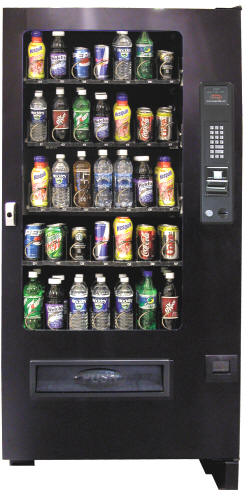
A typical soda machine can have 5 rows, 7 columns, and be 6 sodas deep or 210 sodas total. This means that a stocker will need to come to restock after around 200 bottles are dispensed. If half of the time people come with their own bottle and get it refilled, then the cost of restocking is amortized over 400 bottles. Assuming it takes the stocker an hour to go from the stocking/bottle cleaning location to the machine and back and the stocker is paid $20/hour, that’s five cents per bottle in labor cost.
The cost of syrup is around $35 for 5 gallons of syrup. That amounts to around 200 16-ounce bottles or 18 cents per bottle. That could be as low as 10 cents if the sodas were on the less sweet side. Compared to the syrup, the cost of CO2 is miniscule. In addition to soda, the machine could dispense Hint-like drinks. By their nature, the Hint-like beverages would use very little of the natural flavoring per bottle and could cost less than 10 cents per bottle.
The cost of normal glass soda bottles at scale is around ten to fifty cents. Zero Soda bottles will cost far more than normal, I expect between $1.50 and $2. These will be bottles that are extremely tough and chip and scratch resistant. Imagine a bottle made out of Gorilla Glass. Because they will be tough, they’ll have the possibility of being reused hundreds or thousands of times. One of the goals of the pricing scheme is to heavily incentivize customers to reuse the bottles.
The only other costs to consider are the electricity cost, water cost, space cost, and offsite bottle cleaning costs. The electricity and water cost will come out to be less than a penny per bottle. The cost of renting the space will be around $25 per month. If a machine sells 25 bottles a day, that would add 3 cents of cost to every bottle.
The total cost per bottle accounting for the syrup, labor, utilities, and space for the machine is 26 cents per bottle, just to fill it. In the case where the customer has the machine steam-clean and refill the bottle, Zero Soda could charge 50 cents for a 24 cent profit. If a bottle is returned (for $2 paid to the customer), washed off-site, and returned to the machine empty, I expect it would cost about 10 cents per bottle for the transport and washing. So, a returned bottle costs around $2.35 and sells for $3.50, which is a profit of $1.15, much better than the re-fill. The most profit comes from the first purchase, either $1.15 or $1.65, depending on the manufacturing cost of the bottles.
A typical soda machine can have 5 rows, 7 columns, and be 6 sodas deep or 210 sodas total. This means that a stocker will need to come to restock after around 200 bottles are dispensed. If half of the time people come with their own bottle and get it refilled, then the cost of restocking is amortized over 400 bottles. Assuming it takes the stocker an hour to go from the stocking/bottle cleaning location to the machine and back and the stocker is paid $20/hour, that’s five cents per bottle in labor cost.
The cost of syrup is around $35 for 5 gallons of syrup. That amounts to around 200 16-ounce bottles or 18 cents per bottle. That could be as low as 10 cents if the sodas were on the less sweet side. Compared to the syrup, the cost of CO2 is miniscule. In addition to soda, the machine could dispense Hint-like drinks. By their nature, the Hint-like beverages would use very little of the natural flavoring per bottle and could cost less than 10 cents per bottle.
The cost of normal glass soda bottles at scale is around ten to fifty cents. Zero Soda bottles will cost far more than normal, I expect between $1.50 and $2. These will be bottles that are extremely tough and chip and scratch resistant. Imagine a bottle made out of Gorilla Glass. Because they will be tough, they’ll have the possibility of being reused hundreds or thousands of times. One of the goals of the pricing scheme is to heavily incentivize customers to reuse the bottles.
The only other costs to consider are the electricity cost, water cost, space cost, and offsite bottle cleaning costs. The electricity and water cost will come out to be less than a penny per bottle. The cost of renting the space will be around $25 per month. If a machine sells 25 bottles a day, that would add 3 cents of cost to every bottle.
The total cost per bottle accounting for the syrup, labor, utilities, and space for the machine is 26 cents per bottle, just to fill it. In the case where the customer has the machine steam-clean and refill the bottle, Zero Soda could charge 50 cents for a 24 cent profit. If a bottle is returned (for $2 paid to the customer), washed off-site, and returned to the machine empty, I expect it would cost about 10 cents per bottle for the transport and washing. So, a returned bottle costs around $2.35 and sells for $3.50, which is a profit of $1.15, much better than the re-fill. The most profit comes from the first purchase, either $1.15 or $1.65, depending on the manufacturing cost of the bottles.
Monday, February 18, 2013
Zero Soda - The Idea
I want to make a beverage company that produces zero waste. Here’s how it’ll work.
You are feeling thirsty so you go to a Zero Soda machine and order a drink for three dollars and fifty cents. Out comes a distinctive glass bottle with your beverage of choice: plain soda, diet soda, flavored soda, plain water, mint water, or other naturally flavored waters. The bottle shows that you’re drinking Zero Soda, the bottle cap is the only thing that says what flavor you are drinking. When the drink is dispensed, the machine lets to know that you will get money back if you return the empty bottle to a Zero Soda machine.
Later, you take your bottle to a Zero Soda machine and are given the choice of two dollars back for the bottle or a refill for fifty cents. You opt for the refill and put your bottle in the machine. The machine then steam cleans the bottle, fills it with liquid delight, and gives the bottle back to you. Throughout this process there is near zero waste. The bottle cap is probably the only thing that won’t get recycled all of the time. This makes Zero Soda the first of its kind: a consumer consumption model that results in near zero waste.
Also worth noting is that the machines would communicate the status of the machine wirelessly to the Zero Soda servers using the cell network. The things it would communicate are how much of the syrups and other ingredients are left, how many bottles there are, how much money the machine has collected, and whether the machine will need maintenance soon.
You are feeling thirsty so you go to a Zero Soda machine and order a drink for three dollars and fifty cents. Out comes a distinctive glass bottle with your beverage of choice: plain soda, diet soda, flavored soda, plain water, mint water, or other naturally flavored waters. The bottle shows that you’re drinking Zero Soda, the bottle cap is the only thing that says what flavor you are drinking. When the drink is dispensed, the machine lets to know that you will get money back if you return the empty bottle to a Zero Soda machine.
Later, you take your bottle to a Zero Soda machine and are given the choice of two dollars back for the bottle or a refill for fifty cents. You opt for the refill and put your bottle in the machine. The machine then steam cleans the bottle, fills it with liquid delight, and gives the bottle back to you. Throughout this process there is near zero waste. The bottle cap is probably the only thing that won’t get recycled all of the time. This makes Zero Soda the first of its kind: a consumer consumption model that results in near zero waste.
Also worth noting is that the machines would communicate the status of the machine wirelessly to the Zero Soda servers using the cell network. The things it would communicate are how much of the syrups and other ingredients are left, how many bottles there are, how much money the machine has collected, and whether the machine will need maintenance soon.
Sunday, February 17, 2013
Zero Soda - The motivation
We waste a lot in our society. We have many products that are thrown in landfills after a single use. One of the most commonly used examples is soda/water bottles. A lot of energy and non-renewable (petroleum) resources go into making these bottles only to get thrown away.
Saturday, February 16, 2013
Publisher Payback - The pitch
Wouldn’t it be nice if it was easy to see who provides you with your internet-tainment and pay them back with a little bit of money? With Publisher Payback that’s exactly what you get. With a detailed breakdown of what sites you visit and secure transitions, there’s no reason not to pay back those who help you stave off boredom.
Friday, February 15, 2013
Publisher Payback - The hard part
I think that one of the biggest challenges is going to be building up the user base. It may not be necessary to initially get a bunch publishers on board if you can get some money in the coffers. I don’t see why a publisher would say no to a pile of essentially free money. If it worked well for the publishers, then they may put ads for PP on their site and grow the user base more.
Thursday, February 14, 2013
Publisher Payback - The growth potential
This is a bit hard to estimate, but I’ll give it a go. Suppose PP grows enough that 30% of the US population, ~100 million people use it. If each person values the websites they visit enough to give $20 per month and PP takes a 5% transaction fee, that would add up to $100 million a month or over a billion dollars a year.
Wednesday, February 13, 2013
Publisher Payback - The monetization
Publisher Payback would make money by charging transaction fees when users give money to publishers. I think the transaction fee would be around 5%.
Tuesday, February 12, 2013
Publisher Payback - The idea
Publisher Payback is a piece of software that you install on your internetting devices, computer, phone, or tablet, that tracks the sites you visit. This may sound a lot like spyware but relax; none of the information would be transferred off of your individual internetting device. What the software would do is give you a summary at the end of each month of how many times you visited different blogs and other publishers. You could then use that information to help decide how much money you would like to give to individual publishers. After deciding, you could transfer the money to Publisher Payback (PP) who then gives it to the publishers.
Monday, February 11, 2013
Publisher Payback - The motivation
Content usually costs money to create. If you enjoy reading a blog or frequently use Wikipedia, you may want to help support them financially. Unfortunately, it’s not easy to give money to individual content producers. If the content producers, or publishers, were to accept payments directly, they may not have enough security to make customers feel comfortable handing over their credit card numbers.
Friday, February 8, 2013
Model Gambler - The pitch
Making precise measurements and running experiments are the keys to optimizing businesses. Las Vegas casinos could be making a lot more money by carefully tracking their patrons and patron spending patterns and using that information to design experiments. Stop leaving money on the tablet with Model Gambler.
Thursday, February 7, 2013
Model Gambler - The fun part
There are two parts of this startup idea that I really like. First, I like computer vision and tracking people from one camera into another camera isn’t an easy task. Dealing with partially occluded bodies is another challenge.
Second, I love experiments. With the right infrastructure, it’s possible to run interesting experiments and measure real world results. The best part is that with the camera data you can verify any hypothesis you might have had, e.g., this change will make patrons spend the same amount of money per round but spend more rounds at the blackjack tables.
Second, I love experiments. With the right infrastructure, it’s possible to run interesting experiments and measure real world results. The best part is that with the camera data you can verify any hypothesis you might have had, e.g., this change will make patrons spend the same amount of money per round but spend more rounds at the blackjack tables.
Wednesday, February 6, 2013
Model Gambler - The growth potential
There are 33 casinos on the strip in Las Vegas and about a hundred more throughout the city. The casinos in the city make about $6 billion a year in revenue. I think this software plus the technical advice provided by Model Gambler could increase revenue by 5% a year, or $300 million a year, which would largely go to increased profits. If MG took a ⅓ cut of the increase, that would be $100 million in Las Vegas alone.
If MG grew nationwide, it could make over $8 billion per year in revenue, based on $25 billion in revenue per year made by casinos nationwide.
If MG grew nationwide, it could make over $8 billion per year in revenue, based on $25 billion in revenue per year made by casinos nationwide.
Tuesday, February 5, 2013
Model Gambler - The monetization
Model Gamber would make money through either selling software, or even better, revenue sharing the increased profits from the casino optimization.
Monday, February 4, 2013
Model Gambler - The idea
Las Vegas casinos record everything that happens on the gambling floor. They use this video, as far as I know, exclusively to catch people trying to cheat and others who are banned from gambling. These video streams could be processed to measure the actions of everyone in the casino. You can track individuals over an evening and see how much money they spend and where they spend it.
After the measurement system is in place, it allows the casino to do experiments, preferably A/B testing, on casino patrons. Can you change reorganize the floor of the casino to get people to linger more? Does having only a few people in the casino make it harder for that number to grow? What causes people to stay in a particular area of the casino over another? These questions can be answered by careful analysis of the cash flow and the visual patron tracking data.
Model Gamber (MG) would develop the patron tracking/money spending software and sell it to casinos. MG would also work with casinos to develop good experiments and give advice (and tools) for data analysis.
After the measurement system is in place, it allows the casino to do experiments, preferably A/B testing, on casino patrons. Can you change reorganize the floor of the casino to get people to linger more? Does having only a few people in the casino make it harder for that number to grow? What causes people to stay in a particular area of the casino over another? These questions can be answered by careful analysis of the cash flow and the visual patron tracking data.
Model Gamber (MG) would develop the patron tracking/money spending software and sell it to casinos. MG would also work with casinos to develop good experiments and give advice (and tools) for data analysis.
Sunday, February 3, 2013
Model Gambler - The motivation
Businesses can increase their revenue by getting existing customers to spend more money or by getting new customers; this idea is about the former. Las Vegas casinos are pretty good at making customers shell out money for games for hours on end, but I think they can do better. They have terabytes of idle data that could be making them more money.
Friday, February 1, 2013
Bullseye Brick and Mortar - The pitch
You got into business to make a product or perform a service, not to spend countless hours trying to find a location for your next store. Let BBM use its intelligent algorithms to find the best spots to put your next store. Best of all, BBM is free.
Subscribe to:
Comments (Atom)